Tuesday, November 23, 2004
[446] Of protectionism and Proton
[446] Of protectionism and Proton
Usually in class, I would always stick my eyes to the nearest interesting girl despite my effort to sit in the front row and concentrate on what the professor has to say. However, every now and then, sooner rather than later, there are things in economics that catch my unbelievably short attention span. Impossible as it may seem, sometimes, economics does seem to be more interesting than girls. Last week, the economic issue at hand was, by far, more interesting that anything else.
The subject that was discussed concerned international trade theory. More precisely, it was about a model on industrial clustering and behind that, lurks a case for protectionism.
The idea on industrial clustering is quite simple on the surface – firms in the same industry tend to bunch together due to a few factors of which I won't delve myself in. Despite economics having a notorious reputation of having-a-can-opener assumption, I could see the truth behind this; the Silicon Valley in California, the biotech corridor near the east coast or even the Multimedia Super Corridor in Malaysia though in the latter case, that might provide a failing argument.
The model suggests a downward sloping straight line as the usual demand function and some average cost function as a decreasing downward sloping line that crosses the demand function once. Meanwhile, the y-axis represents cost or price in dollar, naturally and the x-axis, quantity. The graph below expresses the words more elegantly. (I made that myself! I must admit that it is not a demanding chore, however.)
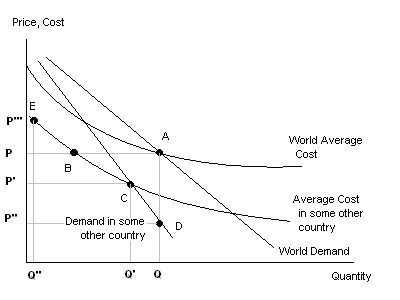
Imagine the farthest demand and the average cost, where point A is on, describe some players in some industry (none of the players is a monopolist. It's a competitive market, just as a caveat if there is any other economic enthusiast out there) supply the world with some particular good. At A, which is the original equilibrium, the product is sold at P per unit and the quantity sold is Q. Consequently, there is Q of such good in the world.
In the graph, there are two average cost lines. The lower line, a line for some country, provides a lower average cost and it would make sense for the firms to move to that country to cut down cost. The firms would do just that but if merely one firm wanted to move to the lower line, it would have to sell its product at price higher than P (at P''' in particular, near point E) but selling at that price is not desirable for the firm because the consumers would only buy from the firms that are selling at P (where P < P'''). So, no one will migrate to the country with the lower cost, unless sufficient number of firms moves there in a concerted form.
Notice that if there are two firms moving to the other country with a lower average cost, it would be able to sell at a price lower than the price where there is only one firm at the lower average cost is able to offer. If there are three firms, the price goes down further. If sufficient firms migrate to other country with lower average cost, the new price will be sold at C, which is P'. If all firms do that, then everybody would sell at P'', which is point D.
Therefore, if the government of the country with the lower average cost wants to improve its economy, the government may want to encourage these firms or some new local firms to set up plants in its country. And in order to do this, a presence of incentive is needed.
And guess what the incentive is?
Subsidy, or some sort of protection – the government will need to subsidize (P''' – P) in order to make firms indifferent between locating their plants in the country with lower average cost and the original location. A little bit more subsidy than (P''' – P) would encourage the firms to be in the country with the lower average cost, in the long run.
As time moves on, as forces of economics force the good quantity in the country to move from somewhere below point B to new equilibrium point C. And that point, the subsidy may be lifted if the price after the lifting is still below price of point A.
I find this extremely surprising and for the rest of the day after knowing this, I couldn’t seem to stop thinking about it - a protectionism policy would encourage a lower price in a competitive market in long run. So far, I've always been thought that subsidy is wasteful due to the presence of deadweight loss. Deadweight loss is simply the possible benefit to both consumers and the producers without any tax or subsidy. And a loss is always bad. But, with protection in this case, it allows greater efficiency in the future. With the idea of intertemporal comes into place, a tradeoff between future and current consumption comes into mind. However, I am almost certain, the ability to consume some level of good at a lower price is preferable for many.
Nevertheless, do you find this surprising?
This result makes me rethink my position in supporting the removal of almost all restrictions to free trade. This also easily describes what the Malaysian government is doing with Proton, a Malaysian firm that produces cars. I find that the government is not merely trying to protect Proton. The government is doing exactly what is described in this model!
But, there are problems. Once the situation reaches the point where subsidy could be removed, it is hard to actually remove it. The reason is more political than sound economic reason.
On Proton, I am not sure whether it is about Proton hasn't reached the point where protection could be lifted or it concerns politics.
In the end, a question remains; after 20 years, one has to wonder why Proton is still protected; is there some other variables left unconsidered or does this model aptly explains Proton’s situation?
p/s - economics is fun!
The subject that was discussed concerned international trade theory. More precisely, it was about a model on industrial clustering and behind that, lurks a case for protectionism.
The idea on industrial clustering is quite simple on the surface – firms in the same industry tend to bunch together due to a few factors of which I won't delve myself in. Despite economics having a notorious reputation of having-a-can-opener assumption, I could see the truth behind this; the Silicon Valley in California, the biotech corridor near the east coast or even the Multimedia Super Corridor in Malaysia though in the latter case, that might provide a failing argument.
The model suggests a downward sloping straight line as the usual demand function and some average cost function as a decreasing downward sloping line that crosses the demand function once. Meanwhile, the y-axis represents cost or price in dollar, naturally and the x-axis, quantity. The graph below expresses the words more elegantly. (I made that myself! I must admit that it is not a demanding chore, however.)
Imagine the farthest demand and the average cost, where point A is on, describe some players in some industry (none of the players is a monopolist. It's a competitive market, just as a caveat if there is any other economic enthusiast out there) supply the world with some particular good. At A, which is the original equilibrium, the product is sold at P per unit and the quantity sold is Q. Consequently, there is Q of such good in the world.
In the graph, there are two average cost lines. The lower line, a line for some country, provides a lower average cost and it would make sense for the firms to move to that country to cut down cost. The firms would do just that but if merely one firm wanted to move to the lower line, it would have to sell its product at price higher than P (at P''' in particular, near point E) but selling at that price is not desirable for the firm because the consumers would only buy from the firms that are selling at P (where P < P'''). So, no one will migrate to the country with the lower cost, unless sufficient number of firms moves there in a concerted form.
Notice that if there are two firms moving to the other country with a lower average cost, it would be able to sell at a price lower than the price where there is only one firm at the lower average cost is able to offer. If there are three firms, the price goes down further. If sufficient firms migrate to other country with lower average cost, the new price will be sold at C, which is P'. If all firms do that, then everybody would sell at P'', which is point D.
Therefore, if the government of the country with the lower average cost wants to improve its economy, the government may want to encourage these firms or some new local firms to set up plants in its country. And in order to do this, a presence of incentive is needed.
And guess what the incentive is?
Subsidy, or some sort of protection – the government will need to subsidize (P''' – P) in order to make firms indifferent between locating their plants in the country with lower average cost and the original location. A little bit more subsidy than (P''' – P) would encourage the firms to be in the country with the lower average cost, in the long run.
As time moves on, as forces of economics force the good quantity in the country to move from somewhere below point B to new equilibrium point C. And that point, the subsidy may be lifted if the price after the lifting is still below price of point A.
I find this extremely surprising and for the rest of the day after knowing this, I couldn’t seem to stop thinking about it - a protectionism policy would encourage a lower price in a competitive market in long run. So far, I've always been thought that subsidy is wasteful due to the presence of deadweight loss. Deadweight loss is simply the possible benefit to both consumers and the producers without any tax or subsidy. And a loss is always bad. But, with protection in this case, it allows greater efficiency in the future. With the idea of intertemporal comes into place, a tradeoff between future and current consumption comes into mind. However, I am almost certain, the ability to consume some level of good at a lower price is preferable for many.
Nevertheless, do you find this surprising?
This result makes me rethink my position in supporting the removal of almost all restrictions to free trade. This also easily describes what the Malaysian government is doing with Proton, a Malaysian firm that produces cars. I find that the government is not merely trying to protect Proton. The government is doing exactly what is described in this model!
But, there are problems. Once the situation reaches the point where subsidy could be removed, it is hard to actually remove it. The reason is more political than sound economic reason.
On Proton, I am not sure whether it is about Proton hasn't reached the point where protection could be lifted or it concerns politics.
In the end, a question remains; after 20 years, one has to wonder why Proton is still protected; is there some other variables left unconsidered or does this model aptly explains Proton’s situation?
p/s - economics is fun!
02:45 EST |
(1) Comments
hmmmm... interesting... i dun think that econs is more interesting than girls... (contemplating)... oklar... econs is at least as interesting as girls are, if not better... ok...i concede... yet to meet u... hahaha..wat a big world after all. :P
By , at 08 March, 2005 00:17


